Niagara System
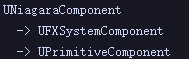
UNiagaraComponent
它继承自UPrimitiveComponent,所以会进行渲染
 1
 2
 3
 4
 5
 6
 7
 8
 9
10
11
12
13
14
15
16
17
18
|
class NIAGARA_API UNiagaraComponent : public UFXSystemComponent{

    // NS的实例,控制粒子计算
	TUniquePtr<FNiagaraSystemInstance> SystemInstance;

    // 在这个组件Tick时,会驱动SystemInstance计算更新 (注意:Solo的走这里,不是Solo的有一个批量的Tick)
	virtual void TickComponent(float DeltaTime, enum ELevelTick TickType, FActorComponentTickFunction* ThisTickFunction) override; // 内部会	check(SystemInstance->IsSolo());

    // 组件注册时,创建渲染状态(创建FNiagaraSceneProxy,发送动态数据)
	virtual void CreateRenderState_Concurrent(FRegisterComponentContext* Context) override;

    // 创建代理
	virtual FPrimitiveSceneProxy* CreateSceneProxy() override;

	// NS资产对应的一个到这个component的实例
	TUniquePtr<FNiagaraSystemInstance> SystemInstance;

}
|
GameTick
Niagara的GameTick分为两种模式,一种是Solo, 走自己的UNiagaraComponent::TickComponent,另外一种走批量,走FNiagaraWorldManager::Tick。并行处理同一个NS资产下的所有实例。
他们的tick最终都会落到FNiagaraSystemSimulation::Tick_GameThread。下面是整体架构
 1
 2
 3
 4
 5
 6
 7
 8
 9
10
11
12
13
14
15
16
17
18
19
20
21
22
23
24
25
26
27
28
29
30
31
32
33
34
35
36
37
38
39
40
41
42
43
44
45
46
47
48
49
50
51
52
53
54
55
56
57
58
59
60
61
62
63
64
65
66
67
68
69
70
71
72
|
flowchart TD
    ENGINE["引擎帧循环<br/>TickTaskManager 按 ETickingGroup 派发"]

    %% ---------- 路径 A:批处理模式 ----------
    subgraph PATHA["路径 A · 批处理模式(默认)"]
        direction TB
        A1["FNiagaraWorldManagerTickFunction::ExecuteTick"]
        A2["FNiagaraWorldManager::Tick(TickGroup)  · :752"]
        A3["遍历 SystemSimulations[TickGroup],逐个 Sim"]
        A1 --> A2 --> A3
    end

    %% ---------- 路径 B:Solo 模式 ----------
    subgraph PATHB["路径 B · Solo 模式"]
        direction TB
        B1["UNiagaraComponent::TickComponent  · :697"]
        B2["SystemInstance->ManualTick / 驱动 Solo Sim"]
        B1 --> B2
    end

    ENGINE --> A1
    ENGINE --> B1

    %% ================= 收敛点:Sim GT 阶段 =================
    SIMGT{{"FNiagaraSystemSimulation::Tick_GameThread  · :1084<br/>★ 所有路径收敛点 · GameThread 串行 ★"}}
    A3 -->|"Sim->Tick_GameThread · :876"| SIMGT
    B2 -->|"Solo Sim 同一入口"| SIMGT

    subgraph GTLOOP["① GameThread 串行阶段(在 Sim::Tick_GameThread 内)"]
        direction TB
        G1["for each Instance:<br/>Instance->Tick_GameThread()  · :1176/:1215"]
        G2["Instance 内部 · :2110<br/>WaitForConcurrentTickAndFinalize<br/>TickInstanceParameters_GameThread<br/>TickDataInterfaces / Age++ / TickCount++"]
        G3["顺带: TickGroup 迁移 & PendingSpawn→Running"]
        G1 --> G2
        G1 --> G3
    end
    SIMGT --> G1

    %% ================= 派发 Sim 并发任务 =================
    GTLOOP -->|"派发 · :1246"| SIMTASK["FNiagaraSystemSimulationTickConcurrentTask<br/>(Worker 线程)"]
    SIMTASK --> SIMCC

    %% ================= ② Sim 并发阶段(System 层) =================
    subgraph CNCLOOP["② Sim::Tick_Concurrent · :1501(Worker,System 层模拟)"]
        direction TB
        SIMCC["Sim::Tick_Concurrent(Context)"]
        C1["PrepareForSystemSimulate(ParallelFor 收集实例参数)· :1530"]
        C2["SpawnSystemInstances(System Spawn 脚本)· :1534"]
        C3["UpdateSystemInstances(System Update 脚本)· :1537"]
        C4["TransferSystemSimResults(结果写回实例)· :1539"]
        C5["for each Instance: AddSystemToTickBatch + FlushTickBatch · :1541"]
        SIMCC --> C1 --> C2 --> C3 --> C4 --> C5
    end

    %% ================= ③ Instance 并发任务(Emitter 层) =================
    C5 -->|"批满即派发"| INSTTASK["FNiagaraSystemInstanceTickConcurrentTask · :395<br/>(Worker,Instance/Emitter 层)"]
    INSTTASK --> INSTCC["for each Inst in Batch:<br/>Inst->Tick_Concurrent()  · :448"]
    INSTCC --> EMIT["Instance::Tick_Concurrent · :2150<br/>遍历 EmitterExecutionOrder<br/>EmitterInstance::PreTick / Tick(真正粒子模拟)"]

    %% ================= ④ Finalize 回收(GameThread) =================
    C5 -->|"派发 Finalize 任务"| FINTASK["FNiagaraSystemInstanceFinalizeTask · :459<br/>(GameThread)"]
    FINTASK --> FINGT["Inst->FinalizeTick_GameThread()<br/>回读模拟结果 / 更新渲染数据 / GPU tick 入队"]

    %% ---------- 样式 ----------
    classDef converge fill:#4a1d12,stroke:#ff7b52,color:#ffe0d6,stroke-width:3px;
    classDef gt fill:#16281c,stroke:#56d364,color:#d7ffdf;
    classDef cnc fill:#182130,stroke:#79c0ff,color:#d7e8ff;
    classDef task fill:#2a2333,stroke:#a371f7,color:#efe6ff;
    class SIMGT converge;
    class G1,G2,G3,FINGT gt;
    class SIMCC,C1,C2,C3,C4,C5,INSTCC,EMIT cnc;
    class SIMTASK,INSTTASK,FINTASK task;
|
 1
 2
 3
 4
 5
 6
 7
 8
 9
10
11
12
13
14
15
16
17
18
19
20
21
22
23
24
25
26
27
28
29
30
31
32
33
34
35
36
37
38
39
40
41
42
43
44
45
46
47
48
49
50
51
52
53
54
55
56
57
58
59
60
61
62
63
64
65
66
67
68
69
70
71
72
73
74
75
76
77
78
|
void FNiagaraSystemSimulation::Tick_Concurrent(FNiagaraSystemSimulationTickContext& Context)
{
	SCOPE_CYCLE_COUNTER(STAT_NiagaraSystemSim_TickCNC);
	SCOPE_CYCLE_COUNTER(STAT_NiagaraOverview_GT_CNC);
	CSV_SCOPED_TIMING_STAT_EXCLUSIVE(Effects);
	LLM_SCOPE(ELLMTag::Niagara);

	FScopeCycleCounterUObject AdditionalScope(Context.System, GET_STATID(STAT_NiagaraOverview_GT_CNC));

	FNiagaraSystemInstance* SoloSystemInstance = bIsSolo && Context.Instances.Num() == 1 ? Context.Instances[0] : nullptr;

	FNiagaraCrashReporterScope CRScope(this);

	if (bCanExecute && Context.Instances.Num())
	{
		if (GbDumpSystemData || Context.System->bDumpDebugSystemInfo)
		{
			UE_LOG(LogNiagara, Log, TEXT("=========================================================="));
			UE_LOG(LogNiagara, Log, TEXT("Niagara System Sim Tick_Concurrent(): %s"), *Context.System->GetName());
			UE_LOG(LogNiagara, Log, TEXT("=========================================================="));
		}

		FScopeCycleCounter SystemStatCounter(Context.System->GetStatID(true, true));

		for (FNiagaraSystemInstance* SystemInstance : Context.Instances)
		{
			SystemInstance->TickInstanceParameters_Concurrent();
		}

		// 跑System脚本
		PrepareForSystemSimulate(Context);

		if (Context.SpawnNum > 0)
		{
			SpawnSystemInstances(Context);
		}

		UpdateSystemInstances(Context);

		TransferSystemSimResults(Context);

		// 整理每个Instance到TickBatch,内部每4个为一批,Flush一次
		for (FNiagaraSystemInstance* Instance : Context.Instances)
		{
			AddSystemToTickBatch(Instance, Context);
		}
		FlushTickBatch(Context);

		// When not running async we can finalize straight away
		if ( !Context.IsRunningAsync() )
		{
			check(IsInGameThread());
			int32 InstanceIndex = 0;
			while (InstanceIndex < Context.Instances.Num())
			{
				FNiagaraSystemInstance* Instance = Context.Instances[InstanceIndex];
				Instance->FinalizeTick_GameThread();

				// Finalize can complete the instance and potentially reactivate
				if (Context.Instances.IsValidIndex(InstanceIndex) && (Context.Instances[InstanceIndex] == Instance))
				{
					++InstanceIndex;
				}

				check(Context.DataSet.GetCurrentDataChecked().GetNumInstances() == Context.Instances.Num());
			}
		}

	#if WITH_EDITORONLY_DATA
		if (SoloSystemInstance)
		{
			SoloSystemInstance->FinishCapture();
		}
	#endif

		INC_DWORD_STAT_BY(STAT_NiagaraNumSystems, Context.Instances.Num());
	}
}
|
在Sim跑Tick_Concurrent内部,会并发对每个Instance执行Tick_Concurrent
  1
  2
  3
  4
  5
  6
  7
  8
  9
 10
 11
 12
 13
 14
 15
 16
 17
 18
 19
 20
 21
 22
 23
 24
 25
 26
 27
 28
 29
 30
 31
 32
 33
 34
 35
 36
 37
 38
 39
 40
 41
 42
 43
 44
 45
 46
 47
 48
 49
 50
 51
 52
 53
 54
 55
 56
 57
 58
 59
 60
 61
 62
 63
 64
 65
 66
 67
 68
 69
 70
 71
 72
 73
 74
 75
 76
 77
 78
 79
 80
 81
 82
 83
 84
 85
 86
 87
 88
 89
 90
 91
 92
 93
 94
 95
 96
 97
 98
 99
100
101
102
103
104
105
106
107
108
109
110
111
112
113
114
115
116
117
118
119
120
121
122
123
124
125
126
|
void FNiagaraSystemInstance::Tick_Concurrent(bool bEnqueueGPUTickIfNeeded)
{
	SCOPE_CYCLE_COUNTER(STAT_NiagaraSystemInst_TickCNC);
	SCOPE_CYCLE_COUNTER(STAT_NiagaraOverview_GT_CNC);
	CSV_SCOPED_TIMING_STAT_EXCLUSIVE(Effects);
	LLM_SCOPE(ELLMTag::Niagara);
	FScopeCycleCounterUObject AdditionalScope(GetSystem(), GET_STATID(STAT_NiagaraOverview_GT_CNC));

	FNiagaraCrashReporterScope CRScope(this);

	// Reset values that will be accumulated during emitter tick.
	TotalGPUParamSize = 0;
	ActiveGPUEmitterCount = 0;
	GPUParamIncludeInterpolation = false;
	UNiagaraSystem* System = GetSystem();

	if (IsComplete() || System == nullptr || CachedDeltaSeconds < SMALL_NUMBER)
	{
		return;
	}

	const int32 NumEmitters = Emitters.Num();
	const TConstArrayView<FNiagaraEmitterExecutionIndex> EmitterExecutionOrder = GetEmitterExecutionOrder();
	checkSlow(EmitterExecutionOrder.Num() <= NumEmitters);

	//Determine if any of our emitters should be ticking.
	TBitArray<TInlineAllocator<8>> EmittersShouldTick;
	EmittersShouldTick.Init(false, NumEmitters);

	bool bHasTickingEmitters = false;
	for (const FNiagaraEmitterExecutionIndex& EmitterExecIdx : EmitterExecutionOrder)
	{
		FNiagaraEmitterInstance& Inst = Emitters[EmitterExecIdx.EmitterIndex].Get();
		if (Inst.ShouldTick())
		{
			bHasTickingEmitters = true;
			EmittersShouldTick.SetRange(EmitterExecIdx.EmitterIndex, 1, true);
		}
	}

	if ( !bHasTickingEmitters )
	{
		return;
	}

	FScopeCycleCounter SystemStat(System->GetStatID(true, true));

	for (const FNiagaraEmitterExecutionIndex& EmitterExecIdx : EmitterExecutionOrder)
	{
		if (EmittersShouldTick[EmitterExecIdx.EmitterIndex])
		{
			FNiagaraEmitterInstance& Inst = Emitters[EmitterExecIdx.EmitterIndex].Get();
			Inst.PreTick();
		}
	}

	int32 TotalCombinedParamStoreSize = 0;

	// now tick all emitters
	for (const FNiagaraEmitterExecutionIndex& EmitterExecIdx : EmitterExecutionOrder)
	{
		FNiagaraEmitterInstance& Inst = Emitters[EmitterExecIdx.EmitterIndex].Get();
		if (EmittersShouldTick[EmitterExecIdx.EmitterIndex])
		{
        	Inst.Tick(CachedDeltaSeconds);   // ← 真正的粒子模拟!
		}

		if (Inst.GetCachedEmitter() && Inst.GetCachedEmitter()->SimTarget == ENiagaraSimTarget::GPUComputeSim && !Inst.IsComplete())
		{
			// Handle edge case where an emitter was set to inactive on the first frame by scalability
			// Since it will not tick we should not execute a GPU tick for it, this test must be symeterical with FNiagaraGPUSystemTick::Init
			const bool bIsInactive = (Inst.GetExecutionState() == ENiagaraExecutionState::Inactive) || (Inst.GetExecutionState() == ENiagaraExecutionState::InactiveClear);
			if (Inst.HasTicked() || !bIsInactive)
			{
				if (const FNiagaraComputeExecutionContext* GPUContext = Inst.GetGPUContext())
				{
					TotalCombinedParamStoreSize += GPUContext->CombinedParamStore.GetPaddedParameterSizeInBytes();
					GPUParamIncludeInterpolation = GPUContext->HasInterpolationParameters || GPUParamIncludeInterpolation;
					ActiveGPUEmitterCount++;
				}
			}
		}
	}

	if (ActiveGPUEmitterCount)
	{
		const int32 InterpFactor = GPUParamIncludeInterpolation ? 2 : 1;

		TotalGPUParamSize = InterpFactor * (sizeof(FNiagaraGlobalParameters) + sizeof(FNiagaraSystemParameters) + sizeof(FNiagaraOwnerParameters));
		TotalGPUParamSize += InterpFactor * ActiveGPUEmitterCount * sizeof(FNiagaraEmitterParameters);
		TotalGPUParamSize += TotalCombinedParamStoreSize;
	}

	// Update local bounds
	if ( System->bFixedBounds )
	{
		LocalBounds = System->GetFixedBounds();
	}
	else
	{
		FBox NewLocalBounds(EForceInit::ForceInit);
		for (const auto& Emitter : Emitters)
		{
			NewLocalBounds += Emitter->GetBounds();
		}

		if (NewLocalBounds.IsValid)
		{
			LocalBounds = NewLocalBounds.ExpandBy(NewLocalBounds.GetExtent() * GNiagaraBoundsExpandByPercent);
		}
		else
		{
			LocalBounds = FBox(FVector::ZeroVector, FVector::ZeroVector);
		}
	}

	//Enqueue a GPU tick for this sim if we're allowed to do so from a concurrent thread.
	//If we're batching our tick passing we may still need to enqueue here if not called from the regular async task. The caller will tell us with bEnqueueGPUTickIfNeeded.
	FNiagaraSystemSimulation* Sim = SystemSimulation.Get();
	check(Sim);
	ENiagaraGPUTickHandlingMode Mode = Sim->GetGPUTickHandlingMode();
	if (Mode == ENiagaraGPUTickHandlingMode::Concurrent || (Mode == ENiagaraGPUTickHandlingMode::ConcurrentBatched && bEnqueueGPUTickIfNeeded))
	{
		GenerateAndSubmitGPUTick();
	}
}
|
之后会串行执行每个EmitterInstance的Tick
在内部会并行tick所有粒子
渲染
 1
 2
 3
 4
 5
 6
 7
 8
 9
10
11
|
class NIAGARA_API FNiagaraSceneProxy : public FPrimitiveSceneProxy
{
private:
	// 每个发射器的Renderer,会在创建Proxy时,创建
	TArray<FNiagaraRenderer*> EmitterRenderers;

	// Renderer 的绘制顺序
	TArray<int32> RendererDrawOrder;

	NiagaraEmitterInstanceBatcher* Batcher = nullptr;
}
|
FNiagaraRenderer 记录每个发射器设置的渲染器,四种渲染器对于四种FNiagaraRenderer的子类
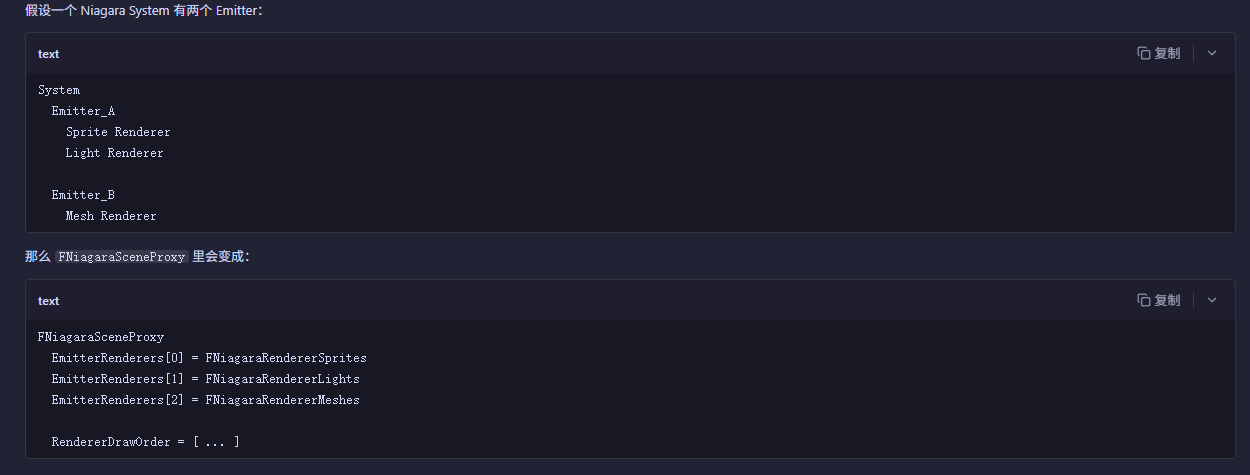
在CreateRenderState_Concurrent中,会执行 SendRenderDynamicData_Concurrent();
1
2
3
4
5
6
7
|
void UNiagaraComponent::CreateRenderState_Concurrent(FRegisterComponentContext* Context)
{
	Super::CreateRenderState_Concurrent(Context);
	// The emitter instance may not tick again next frame so we send the dynamic data here so that the current state
	// renders.  This can happen when while editing, or any time the age update mode is set to desired age.
	SendRenderDynamicData_Concurrent();
}
|
在SendRenderDynamicData_Concurrent内部会遍历每个发射器下的每个Renderer,执行它的
NewData = Renderer->GenerateDynamicData(NiagaraProxy, Properties, EmitterInst);并设置到渲染线程
渲染流程
在标准渲染流程中,UE Renderer 收集场景 Primitive 时,会调用 FPrimitiveSceneProxy::GetDynamicMeshElements,就会进入NS的GetDynamicMeshElements,此时NS系统会向渲染器注册MeshBatch,进入渲染流程
所有粒子系统和其他可渲染组件原来是一样的
 1
 2
 3
 4
 5
 6
 7
 8
 9
10
11
12
13
14
15
16
17
18
19
20
21
22
23
24
25
26
27
28
29
30
31
32
33
|
void FNiagaraSceneProxy::GetDynamicMeshElements(const TArray<const FSceneView*>& Views, const FSceneViewFamily& ViewFamily, uint32 VisibilityMap, FMeshElementCollector& Collector) const
{
	SCOPE_CYCLE_COUNTER(STAT_NiagaraOverview_RT);
	SCOPE_CYCLE_COUNTER(STAT_NiagaraComponentGetDynamicMeshElements);

#if STATS
	FScopeCycleCounter SystemStatCounter(SystemStatID);
#endif

	for (int32 RendererIdx : RendererDrawOrder)
	{
		FNiagaraRenderer* Renderer = EmitterRenderers[RendererIdx]; // 这就是前边的每个渲染器组织
		if (Renderer && (Renderer->GetSimTarget() != ENiagaraSimTarget::GPUComputeSim || FNiagaraUtilities::AllowGPUParticles(ViewFamily.GetShaderPlatform())))
		{
			Renderer->GetDynamicMeshElements(Views, ViewFamily, VisibilityMap, Collector, this);  // 实际会进入每个Renderer自己的GetDynamicMeshElements,内部就是收集MeshBatches
		}
	}

	if (ViewFamily.EngineShowFlags.Particles && ViewFamily.EngineShowFlags.Niagara)
	{
		for (int32 ViewIndex = 0; ViewIndex < Views.Num(); ViewIndex++)
		{
			if (VisibilityMap & (1 << ViewIndex))
			{
				RenderBounds(Collector.GetPDI(ViewIndex), ViewFamily.EngineShowFlags, GetBounds(), IsSelected());
				if (HasCustomOcclusionBounds())
				{
					RenderBounds(Collector.GetPDI(ViewIndex), ViewFamily.EngineShowFlags, GetCustomOcclusionBounds(), IsSelected());
				}
			}
		}
	}
}
|
并不是所有Renderer都走这个路径,LightRenderer走GatherSimpleLights,组件Renderer更特殊

Niagara生命周期
Activate
